 TP MASTER LAB
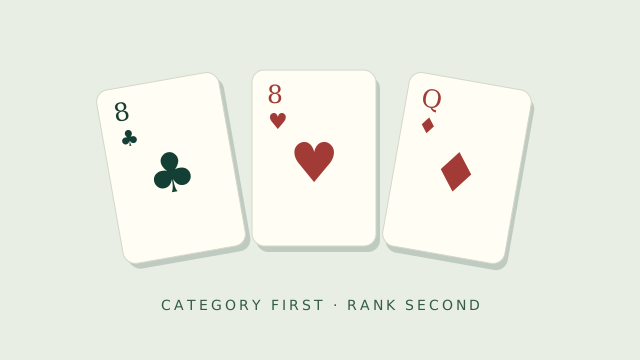
Hand order at a glance
| Rank | Hand | Illustration | Beats |
|---|---|---|---|
| 1 | Trail / trio | 9♠ 9♥ 9♦ | All categories below |
| 2 | Pure sequence | 5♥ 6♥ 7♥ | Sequence, colour, pair, high card |
| 3 | Sequence | 5♥ 6♣ 7♦ | Colour, pair, high card |
| 4 | Colour | A♣ J♣ 8♣ | Pair, high card |
| 5 | Pair | 8♠ 8♦ 3♥ | High card |
| 6 | High card | K♠ J♦ 8♥ | A lower high-card hand |
The same three cards belong to only one category in this reference. A pure sequence is not counted again as a colour or ordinary sequence. That distinction also matters when calculating hand probabilities.
How tie-breaks work
For trails, compare the repeated rank. For pairs, compare the paired rank first; only equal pairs need the third card, called the kicker. A pair of queens with a two beats a pair of jacks with an ace.
For colour and high card, sort ranks from high to low and compare in order. A♠ J♠ 8♠ beats A♥ 10♥ 9♥ because the second card decides it. In the standard model suits have no extra ranking, so equal rank patterns in different suits can be tied.
A tied card comparison does not always mean the round is shared. Some show or sideshow procedures give a tie consequence to the requester. Read the mode’s comparison rule separately from its hand-ranking rule.
A23 versus AKQ: establish the convention
Both A-2-3 and A-K-Q can be valid runs, but references and tables differ on their relative strength. Never assume that your app follows a convention you used elsewhere. K-A-2 is not a normal consecutive run in the model used here.
Our probability table treats both endpoint runs as valid. It does not need to decide which one ranks higher. If a mode removes one endpoint, uses a special ace order or introduces jokers, its counts and comparisons need a separate calculation.
Explore one category at a time
This explorer explains a category; it does not inspect a live app or predict a result. You can use the static table without JavaScript. Try covering the “Hand” column and naming each example before checking it.